
Do you remember when your body used to feel like a fluid, cohesive unit?
There was a time when you could reach for a seatbelt, squat down to tie a shoelace, or simply roll over in bed without a second thought. But for many women navigating the transition of perimenopause and menopause, that sense of effortless movement slowly evaporates. It is replaced by a feeling of being ” disjointed.” You might feel as though your hip does not quite belong to your leg, or that your shoulders are wearing a heavy, invisible yoke.
In the therapy world, we often hear clients say they feel “rusty” or “stuck.”
When you feel this way, the instinct is often to look for a massage therapist who will simply “rub the muscles” or press hard into the knots. While deep tissue work has its place, the menopausal body requires something more sophisticated. It requires movement. It requires rhythm.
This is where Rhythmic Mobilisation comes in.
As a holistic therapist trained in the Bristol Diploma method, I do not view you as a slab of meat to be pummelled. I view you as a dynamic, living system that has temporarily lost its rhythm. By integrating rocking, shaking, and oscillating movements into your treatment, we do not just treat the muscle; we treat the fluid dynamics of your body and the safety settings of your nervous system.
Here is the science of why movement is medicine, especially when your hormones are shifting.
The “Frozen” Feeling: Why Menopause Makes Us Stiff
To understand why we need mobilisation, we must first understand the biology of the stiffness. Why does perimenopause make us feel like the Tin Man?
The answer lies in the relationship between Oestrogen and your soft tissues.
Oestrogen is a master regulator of hydration in the body. It stimulates the production of collagen and helps your tissues hold onto water. As oestrogen levels decline, your connective tissues (fascia), tendons, and ligaments lose some of their water content. They become drier and less elastic.
Imagine a fresh sponge compared to a dry, brittle one. A fresh sponge bends easily. A dry sponge resists movement and feels stiff.
Additionally, we have the issue of Synovial Fluid. This is the egg-white-like substance that lubricates your joints. Oestrogen helps stimulate the production of this fluid. When levels drop, your joints literally have less “oil” in the gears. This leads to that creaky, friction-filled sensation in the hips, knees, and spine.
Standard static massage (where the therapist presses on one spot while you lie still) can help muscle tension. However, it does not always address this deep-seated dryness or the structural feeling of being “stuck.”
What is Rhythmic Mobilisation?
Rhythmic Mobilisation is a core pillar of the Bristol approach to bodywork. It distinguishes a high-end holistic treatment from a standard spa routine.
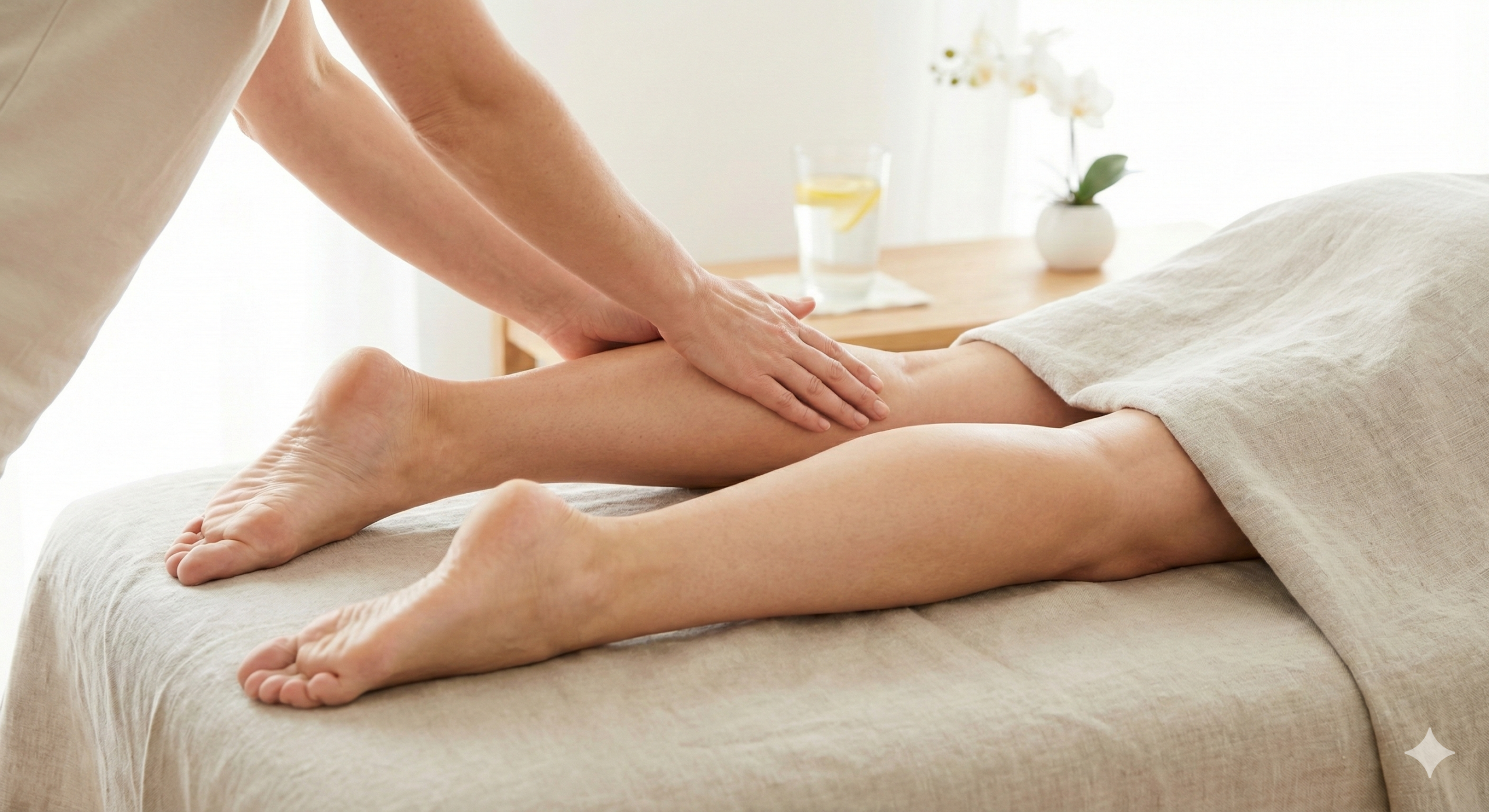
Instead of just gliding over the skin, I use my hands and body weight to create waves of motion throughout your body. This might look like:
- Gentle rocking of the pelvis to release lower back tension.
- Oscillating the shoulder joint to remind it of its full range of motion.
- “Shaking” the muscles of the legs to confuse tension patterns.
- Tractioning (gently pulling) the neck or limbs to create space in the joints.
It is not chaotic; it is hypnotic. We work with the natural rhythms of your body to coax it back into a state of flow.
The Science: Why the “Wobble” Works
You might wonder how gentle rocking can be as effective as deep pressure. The answer lies in three fascinating physiological mechanisms: Thixotropy, The Gate Control Theory, and Proprioception.
1. Thixotropy: Turning Gel into Liquid
This is one of my favourite concepts in bodywork. Thixotropy is a property of certain gels and fluids (including your fascia and synovial fluid) where they become more fluid when they are shaken or stirred, and more solid when they sit still.
Think of a bottle of ketchup. If you turn it upside down, nothing comes out. It is stuck. But if you tap the bottle or give it a good shake, the sauce suddenly becomes runny and flows easily.
Your fascia works the same way. When you are sedentary or when inflammation is high due to cortisol, your fascia becomes sticky and gel-like.
The Intervention: By applying rhythmic mobilisation (shaking, rocking, and rotating limbs), I am physically agitating the ground substance of your fascia.The Benefit: We turn that “solid” gel back into a fluid state. This allows your muscles to slide over each other again, reducing friction and restoring that feeling of elasticity. We are literally rehydrating your tissues through movement.
2. The Gate Control Theory: Confusing the Pain
Chronic pain is common in menopause. Whether it is an old injury flaring up or general systemic aching, pain signals travel to the brain via nerve fibres.
The Gate Control Theory of Pain suggests that non-painful input (like movement or vibration) closes the “gates” to painful input. The brain can only process so much sensation at once.
The Intervention: When I rhythmically rock a painful hip or shoulder, I am flooding your nervous system with movement data.The Benefit: These movement signals travel faster than pain signals. They essentially “jam the line” to the brain. Your brain becomes so busy processing the pleasurable sensation of the rhythm that it forgets to process the pain signal. This provides immediate relief and breaks the cycle of pain-spasm-pain.
3. Proprioception: Finding Your Body Again
Brain fog does not just affect your memory; it affects your movement.
Proprioception is your brain’s ability to know where your body is in space. During perimenopause, hormonal fluctuations can dull these signals. You might feel clumsy, bump into doorframes, or just feel disconnected from your physical self.
The Intervention: Mobilisation provides rich sensory feedback. When I move your arm for you, or rotate your ankle, thousands of sensors in your joints send pings to your brain saying “I am here, this is where I start and end.” The Benefit: This updates your internal body map. It helps you feel grounded and embodied. When your brain knows exactly where your joints are, it feels safer, and it releases the protective muscle guarding that causes stiffness.
The Nervous System Connection: Why Rhythm Soothes
Beyond the mechanics of joints and fluids, rhythmic mobilisation is a love letter to your nervous system.
We are biologically wired to find rhythm soothing. We were rocked in the womb. We rock babies to sleep. We sway when we are in distress. Rhythm is a primal signal of safety.
Many women arrive at my clinic in a state of high Sympathetic arousal (Fight or Flight). Their bodies are rigid because they are subconsciously bracing against the world. Static pressure, if applied too quickly to a stressed body, can sometimes trigger more bracing.
Rhythm bypasses this defence.
Because the movements I use are repetitive and predictable, your brain quickly labels them as “safe.” The rocking motion stimulates the Vestibular System (inner ear), which has a direct link to the Vagus Nerve.
As the session progresses, the rhythm acts like a lullaby for your nervous system. Your heart rate slows to match the pace of the massage. Your breathing deepens. The cortisol floodgates close, and the serotonin starts to flow.
What Does a Session Feel Like?
If you have only ever had static massage, a session incorporating Bristol-style mobilisation can feel like a revelation.
It feels like “letting go.”
Clients often describe feeling like they are floating on water. Because I am supporting the weight of your limbs, you experience a sense of weightlessness. You do not have to hold your leg up; I have got it. You do not have to hold your head up; I am supporting it.
This surrender is incredibly powerful for the menopausal woman who spends her entire life “holding up” everyone else (aging parents, children, colleagues). For an hour, you do not have to hold anything. You can simply allow yourself to be moved.
Extending the Flow: Your Home Care
While I can facilitate this fluidity in the treatment room, you can keep the “thixotropic” effect going at home with simple habits:
- The Morning Bounce: Before you try to stretch cold muscles, just bounce. Stand on your carpet and gently bounce on your heels. Shake your hands. Wiggle your hips. Remember the ketchup bottle (shake it to wake it).
- Hydrate for Fascia: Water is essential, but electrolytes help your tissues absorb it. Add a pinch of sea salt or a slice of lemon to your water bottle.
- Walk with Swing: When you walk, allow your arms to swing and your hips to rotate. Avoid holding yourself rigid.
Reclaiming Your Vibrancy
You are not destined to stiffen up and slow down. The feeling of “rust” is simply a signal that your body needs a different kind of maintenance.
It needs oiling. It needs movement. It needs to be reminded that it is safe to move freely.
By combining the deep tissue work you know with the rhythmic mobilisation you need, we create a treatment that honours the complexity of your changing physiology. We move you from “static and stuck” to “fluid and free.”
It is time to get your rhythm back.