
Do you ever look in the mirror and feel like the person staring back is slightly out of focus?
I am not talking about your eyesight. I am talking about a deep, unsettling sensation that you are slowly fading away.
In my clinic, women describe this feeling to me in whispers. They say things like, “I feel like a ghost in my own house,” or “I know my arm is there, but I don’t really feel it.” They describe walking down the street and feeling as though people are walking right through them.
We often talk about the “invisibility of middle age” as a social issue. We talk about how society stops noticing women once they pass forty. While that is a valid cultural conversation, there is something much more visceral and biological happening here.
You are not just feeling ignored by the world. You are feeling disconnected from your own physical form.
This sensation is known as Dissociation or Depersonalisation, and it is a surprisingly common, yet rarely discussed, symptom of the menopausal transition. It is the feeling that your edges are blurring.
As a holistic therapist, I want you to know that you are not losing your mind. You are simply losing your map. And the most effective way to redraw that map, to make the edges of “You” crisp and clear again, is through the science of informed, grounding touch.
Here is why you feel like you are floating away, and how we can bring you back down to earth.
The Science of “The Blur”: What is Happening to My Brain?
To understand why you feel disconnected, we have to look at how your brain understands reality.
Your brain sits in a dark box (your skull). It has never seen your hand or your foot. It only knows they exist because it receives a constant stream of electrical signals from nerves in your skin, joints, and fascia.
This stream of data is processed in two key areas:
- Proprioception: The sense of where your body is in space (movement).
- Interoception: The sense of the internal state of the body (heartbeat, hunger, temperature, emotion).
The Oestrogen Connection
Oestrogen is a master regulator of neural transmission. It helps these electrical signals travel fast and loud. When oestrogen levels fluctuate and drop during perimenopause, the volume on these signals gets turned down.
Suddenly, the signal from your left foot to your brain is not a shout; it is a whisper. The signal from your gut isn’t a clear text message; it is static.
The Cortisol Cloud
Simultaneously, menopause is often a time of high stress. When cortisol (the stress hormone) floods the system, the brain enters a survival mode known as “functional freeze” or dissociation.
In this state, the brain decides that feeling the body is too overwhelming. To protect you, it numbs the connection. It creates a buffer zone between your conscious mind and your physical sensations.
The Result: You lose your “edges.” You stop feeling where you end and the rest of the world begins. This is not just a poetic metaphor; it is a neurological dampening of the Parietal Lobe, the part of the brain responsible for maintaining your body schema.
Why “Not Feeling Real” is Dangerous
Living in this disconnected state is exhausting.
When you cannot feel your edges, you feel unsafe. The nervous system relies on boundaries to know it is secure. If the walls of your house suddenly became invisible, you would feel anxious, exposed, and vigilant.
The same happens in the body. When your internal map is blurry, you experience:
- High-level anxiety: A constant, humming dread that has no specific cause.
- Clumsiness: You bump into tables or drop mugs because your brain is guessing where your hand is.
- Emotional porousness: You find yourself absorbing other people’s moods. If your partner is grumpy, you become grumpy. If your friend is sad, you are devastated. Without physical boundaries, you lose your emotional boundaries too.
The Massage Intervention: Redrawing the Outline
This is where the Bristol Diploma approach to bodywork becomes a vital medical intervention. We are not just relaxing muscles. We are engaging in Sensory Re-integration.
To fix the blur, we need to show the brain exactly where the body is. We need to use touch to say, “Here. You start here. You end here. This is your boundary.”
Here are the specific techniques I use to help you reclaim your edges.
1. Broad, Firm Compression (The “Container” Principle)
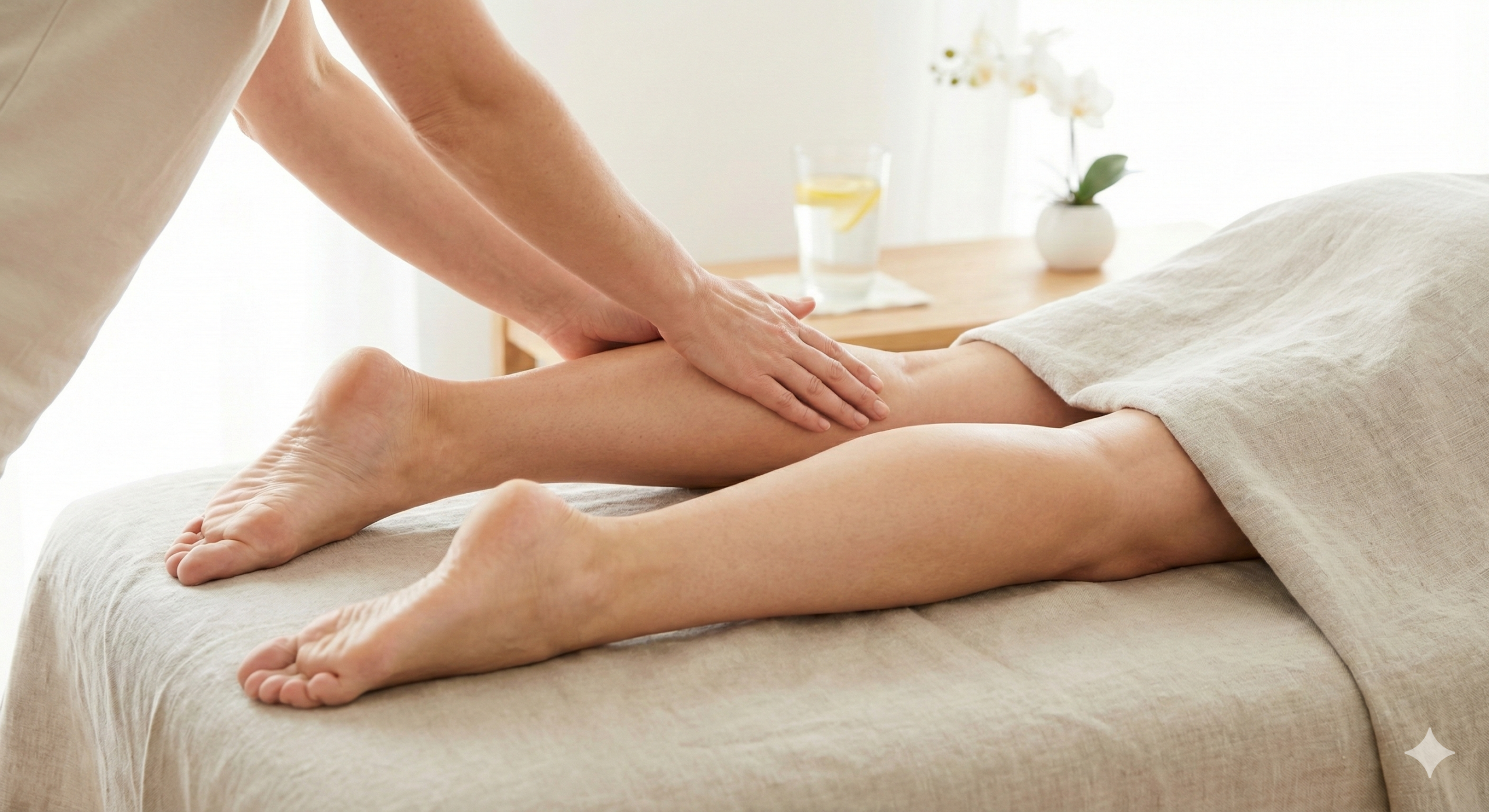
Light, feathery touch can sometimes make dissociation worse. It can feel ticklish or irritating to a nervous system that is already ungrounded. Instead, I use slow, heavy, broad-handed pressure. I might squeeze the upper arms, press firmly down on the hips, or compress the feet.
- The Science: This stimulates the Pacinian Corpuscles, the nerve endings deep in the skin that respond to firm pressure. These receptors send a high-priority signal to the brain that cuts through the hormonal static. It acts like a weighted blanket, flooding the brain with safety signals and confirming the physical limits of the body.
2. Working the Peripheries
When we are stressed, we retreat into our heads. We vacate the extremities.
- The Technique: I spend significant time working on the hands, the feet, and the scalp. I might firmly massage each finger or create space between the toes.
- The Benefit: By waking up the furthest points of your body, we force the brain to expand its map back out to full size. You physically feel yourself “filling out” your skin again.
3. Fascial Definition (The “Edges” Principle)
The fascia is the wetsuit that wraps your body. It defines your shape.
- The Technique: Using slow, myofascial spreading techniques, I trace the major muscle groups. I work along the IT band (the side of the thigh), the crest of the hips, and the line of the shoulders.
- The Mechanism: This provides the brain with a clear outline. It is like taking a black marker pen and tracing over a faint pencil drawing. Suddenly, the image becomes sharp.
The Emotional Shift: Finding Your “No”
One of the most profound side effects of reclaiming your physical edges is that you reclaim your emotional authority.
Many women in midlife suffer from “permeable boundaries.” We say yes when we mean no. We over-give to our children, our aging parents, and our bosses, leaving nothing for ourselves. We pour ourselves out until we feel diluted.
This emotional behaviour is mirrored in the body. If you cannot feel your skin, you cannot feel your limit.
When you lie on my table and I compress your shoulders or squeeze your feet, you are reminded that you are a finite container. You are not an endless resource. You have a beginning and an end.
Clients often tell me that after a “Grounding & Boundaries” session, they find it easier to set limits. They go home and tell their teenagers to cook their own dinner. They decline the extra project at work.
By firming up the physical container, we firm up the spirit inside it. You remember that you are allowed to take up space. You remember that you are solid.
Interoception: The Path Home
Beyond just boundaries, we work on Interoception. This is the ability to hear the quiet signals of the body before they become screams.
During a session, I might ask you questions designed to spark this sense: “Can you feel the warmth of my hand on your lower back?” “Does this area feel tighter or looser than the left side?” “Notice how your breath changes when I hold your feet.”
I am not asking because I need the answer. I am asking to direct your attention inward.
By inviting you to notice these subtle sensations, we exercise the Insula part of your brain. Like a muscle, the more you use it, the stronger it gets. Over time, this reduces the “floating” feeling. You become anchored in your physical experience. You stop living in your head (the past/future) and start living in your body (the present).
Your Home Practice: Anchoring the Edges
You cannot stay on the massage table forever, so you need tools to maintain this sense of definition at home. Here are three holistic practices to help you find your edges when the fog rolls in:
1. The “Self-Squeeze”
This is a technique often used in trauma therapy to treat dissociation.
- How to do it: Start at your left shoulder. Use your right hand to firmly squeeze your way down your arm, all the way to the fingertips. Squeeze hard enough to feel the resistance of the muscle. Repeat on the other side. Then squeeze down your legs.
- The Affirmation: As you do it, you can silently say, “This is my arm. I am here.”
- Why it works: It provides immediate proprioceptive feedback to the brain, reducing anxiety and bringing you back into the room.
2. Dry Body Brushing
We often think of this for cellulite, but it is actually a powerful neurological tool.
- How to do it: Before your shower, use a coarse bristle brush to sweep over your skin.
- Why it works: The scratchy texture stimulates the superficial nerve endings (C-tactile afferents). It wakes up the boundary of your skin, defining exactly where “You” meet the air.
3. Weighted Comfort
If you feel particularly “ghost-like” in the evenings, use weight.
- How to do it: Use a weighted blanket, or simply pile heavy cushions on your lap while you sit on the sofa.
- Why it works: Deep pressure stimulation calms the sympathetic nervous system (fight/flight) and engages the parasympathetic system (rest/digest/connect). It makes you feel held.
You Are Real. You Are Here.
The transition of menopause involves a lot of shedding. We shed our fertility, our collagen, and often our old identities. It is natural to feel a little lost in the process.
But you do not have to fade away.
Your body is the vessel that carries you through this life. It deserves to be felt. It deserves to be acknowledged. It deserves to be touched with intention and respect.
If you are feeling blurry, disconnected, or invisible, please know that we can fix this. We can use the power of deep, rhythmic, boundary-defining touch to bring you back into focus.
You are not a ghost. You are a vibrant, solid, and powerful woman. Sometimes, you just need a reminder of exactly where you stand.