
Have you walked into a room and forgotten why you are there?
Perhaps you have found yourself bumping into the doorframe on your way out. Maybe you have dropped your keys three times in one morning, or felt a sudden, inexplicable clumsiness that makes you feel like you are moving through treacle.
For millions of women navigating perimenopause and menopause, these moments are not just annoying. They are frightening. They trigger a deep, quiet panic. We worry about early-onset dementia. We worry that we are losing our edge at work. We worry that we are slowly fading away.
We label this “Brain Fog.”
It is the catch-all term for the cotton-wool feeling that descends on our cognitive function during midlife. But what if I told you that much of what you are experiencing isn’t just a failure of your memory? What if it is actually a failure of your body’s GPS system?
This system is called Proprioception.
As a holistic therapist, I see this disconnect every day. Clients lie on my table and tell me they feel “floating” or “untethered.” By understanding the science of proprioception and how massage therapy can recalibrate it, we can offer you a powerful pathway back to clarity. You do not just need to write more lists. You need to get back into your body.
The Science: What is Proprioception?
Proprioception is often called your “sixth sense.” It is the continuous, unconscious feedback loop that tells your brain where your body is in space.
Imagine closing your eyes and touching your nose with your finger. You can do this because of proprioception. Millions of tiny sensors—called mechanoreceptors—located in your joints, muscles, fascia, and skin are constantly pinging your brain with data.
They say things like: The knee is bent at 45 degrees. The foot is on solid ground. The arm is reaching forward.
Your brain takes this massive stream of data and creates a 3D map of “You.” This allows you to walk without looking at your feet and type without looking at the keyboard.
The Menopause Disconnect
So, what happens when hormones shift?
1. The Oestrogen Effect on Nerves Oestrogen is neuroprotective. It supports the health and speed of nerve signal transmission. When oestrogen levels fluctuate and drop, the speed at which these signals travel from your ankle to your brain can slow down slightly. The signal becomes “fuzzy.”
- The Result: You might trip over a kerb because your brain didn’t register the lift of your foot quite fast enough.
2. The “Noisy” Brain During perimenopause, the brain is often in a state of hyper-arousal (thanks to cortisol spikes and sleep disturbances). It is busy managing hot flushes, anxiety loops, and temperature regulation.
- The Result: The brain prioritises survival signals over movement signals. The subtle data from your proprioceptors gets drowned out by the noise. Your internal map becomes blurry.
3. Fascial Dehydration As we discussed in previous posts, lower oestrogen leads to dehydrated fascia. When connective tissue is stiff and dry, the mechanoreceptors trapped inside it cannot fire effectively.
- The Result: The sensors are muted. Your brain literally receives less data about where your body ends and the world begins.
This physical disconnect creates a massive cognitive load. Your brain has to work twice as hard just to navigate the room. No wonder you can’t remember where you put your glasses—your brain is too busy trying to keep you upright.
Signs Your “Brain Fog” is Actually Body Disconnect
How do you tell the difference between fatigue and a proprioceptive deficit? Look for these physical symptoms that often accompany the mental fuzziness:
- Unexplained Clumsiness: You are knocking over drinks, catching your hip on table corners, or dropping items.
- The “Floaty” Feeling: You feel ungrounded, as if you are walking slightly above the floor.
- Dyspraxia-like Symptoms: You struggle with fine motor skills, like fastening buttons or handwriting, which feels messier than usual.
- Visual Reliance: You find you have to look at your feet when walking on uneven ground, or you feel very unsteady in the dark.
- Physical Anxiety: A sense of unease that seems to come from your limbs rather than your thoughts.
If this sounds like you, the solution involves reconnecting the wiring between your body and your brain.
The Massage Intervention: Recalibrating Your GPS
This is where the Bristol Diploma approach to bodywork becomes essential. We are not just smoothing out knots. We are engaging in sensory re-education.
To fix the disconnect, we need to flood the brain with high-quality sensory information. We need to wake up those dormant mechanoreceptors and force the brain to update its internal map.
Here is how we use specific massage techniques to clear the fog.
1. Joint Mobilisation (The “Movement” Principle)
Mechanoreceptors are highly concentrated in the joint capsules (where bones meet). Static pressure doesn’t stimulate them nearly as well as movement does.
- What we do: I use rhythmic oscillations, rotations, and gentle traction on the wrists, ankles, hips, and shoulders.
- The Mechanism: Every time I rotate your wrist or rock your hip, thousands of nerve endings fire a signal to the brain. It is like refreshing a webpage. The brain receives a clear, crisp signal: “Here is the hip. Here is the limit of movement.”
- The Benefit: This reduces the background processing power your brain was using to guess where your limbs were. This frees up cognitive energy for thinking, remembering, and focusing.
2. Compression and Grounding (The “Touch” Principle)
Anxiety and brain fog often make us feel physically light and untethered. We need to remind the body of its boundaries.
- What we do: I use broad, firm compression techniques, pressing down through the shoulders, hips, and feet.
- The Mechanism: This stimulates the deep pressure receptors (Pacinian corpuscles). These receptors have a direct calming effect on the Reticular Activating System (RAS) in the brainstem, which controls alertness and panic.
- The Benefit: You feel physically heavier and more “contained.” When you feel solid in your body, the mental spinning slows down.
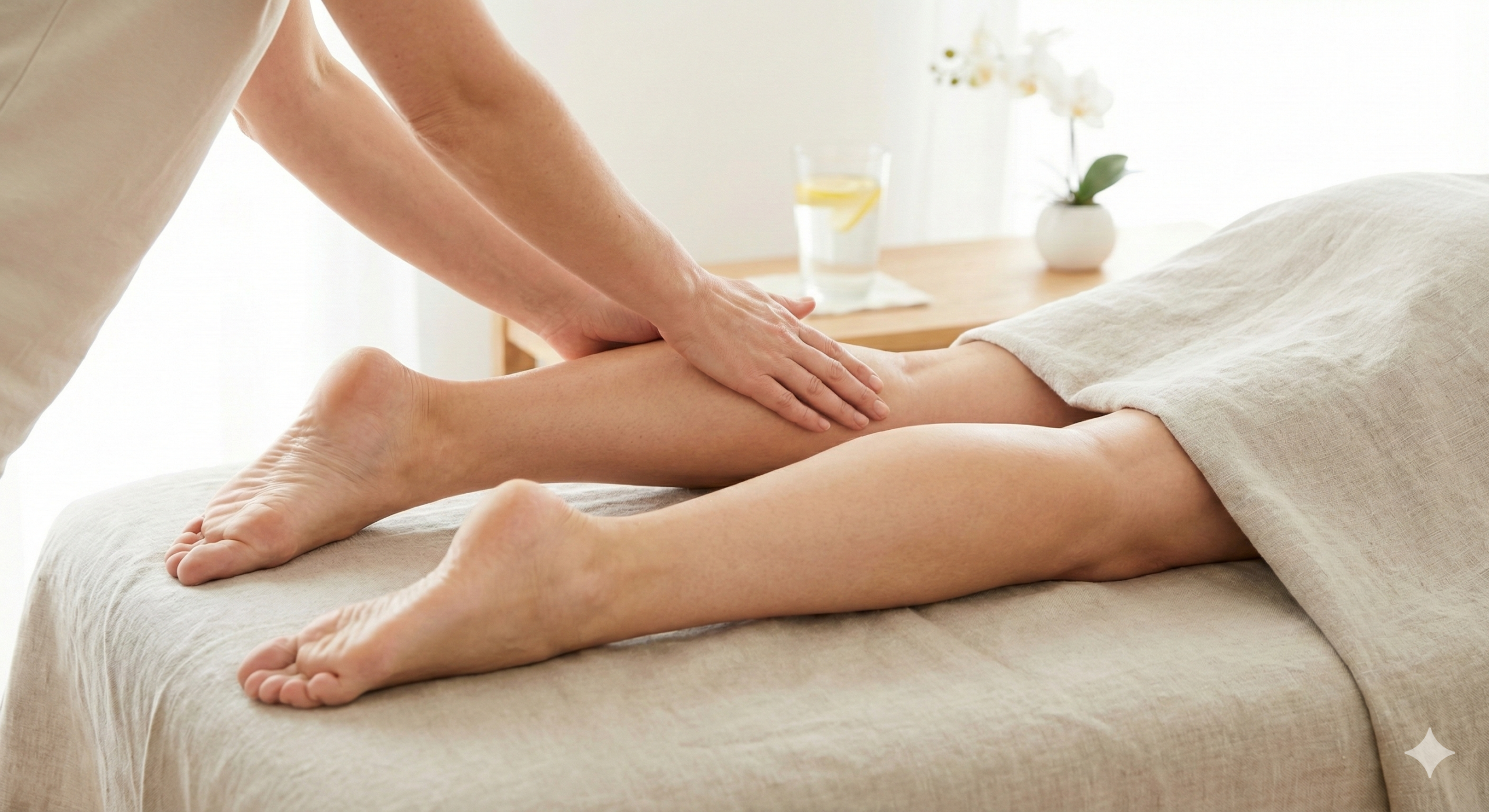
3. Foot and Hand Focus
The hands and feet have the highest density of nerve endings in the body. They are your primary interface with the world. Yet, we often ignore them in standard back massages.
- What we do: I dedicate significant time to opening the fascia of the palms and the soles of the feet, separating the metacarpals and stimulating the toes.
- The Mechanism: This “turns on” the sensory extremities.
- The Benefit: Improved balance and a feeling of being able to “grasp” the world again—both physically and metaphorically.
The Emotional Relief of Being “Found”
There is a profound emotional component to proprioceptive work.
Perimenopause can be an incredibly isolating experience. Many women describe feeling invisible in society. When you add the physical sensation of body dissociation, it can feel as though you are disappearing entirely.
When I hold a client’s head securely, or firmly compress their shoulders, I am offering a tactile confirmation of their existence.
The massage table becomes a safe container where you can be fully present. You do not have to think. You do not have to manage a schedule. You just have to feel.
Clients often get off the table and say things like: “I feel like my eyes are wider open.” “I feel taller.” “The room looks sharper.”
This is not magic. It is neurology. By cleaning up the sensory input from the body, we have cleared the static from the brain.
Your “Clarity Toolkit” at Home
You can continue this sensory re-education between treatments. Here are three simple, holistic exercises to boost proprioception and banish brain fog:
1. The Barefoot Walk (Earthing)
Modern shoes cushion us so much that our feet stop talking to our brains.
- The Practice: Walk barefoot on grass, sand, or even a textured rug in your home for 5 minutes a day.
- Why it works: The varied textures stimulate the plantar sensors, forcing your brain to pay attention to the ground. This is instantly grounding for a racing mind.
2. Conscious Balancing
Balance is the quickest way to engage proprioception.
- The Practice: While brushing your teeth, stand on one leg. If that is easy, try closing your eyes (safely, near a wall!).
- Why it works: Closing your eyes removes visual input, forcing your brain to rely entirely on internal body signals to keep you upright. It is a high-intensity workout for your nervous system.
3. Skin Brushing
Dry brushing isn’t just for exfoliation.
- The Practice: Use a firm bristle brush to sweep over your arms and legs before a shower.
- Why it works: The scratching sensation wakes up the superficial nerve endings on the skin, creating a clear boundary of where “you” begin.
Reclaiming Your Cognitive Space
Please stop telling yourself that you are losing your mind. You are likely just losing your connection.
The brain is an expensive organ to run. It uses 20% of your body’s energy. When it has to fight through hormonal noise and sensory silence just to keep you walking straight, it has no energy left for finding your keys or remembering a name.
By supporting your body with Holistic Massage and Proprioceptive work, we reduce that physical load. We make moving easy again. We make the body feel safe, solid, and mapped.
And when the body is clear, the mind follows.
Frequently Asked Questions (FAQ)
Can massage really help with memory loss? Massage is not a cure for dementia or clinical memory loss. However, it significantly reduces cortisol (stress) and improves sleep. Since stress and exhaustion are the two biggest causes of “menopause brain,” alleviating them often results in much sharper cognitive function.
I feel dizzy sometimes. Is this related? Dizziness can be a symptom of perimenopause (related to blood pressure or inner ear changes). Proprioceptive massage helps ground the body and can improve stability, but if you experience sudden or severe dizziness, please consult your GP first to rule out other causes.
Does this massage hurt? Not at all. Proprioceptive work is about clarity, not pain. The techniques involve firm pressure (squeezing) and rhythmic movement, which most clients find deeply reassuring and comforting, like a weighted blanket.
How often do I need this treatment? If you are in a period of high stress or intense brain fog, a weekly session for 3 to 4 weeks can help reset the nervous system. After that, a monthly maintenance session is usually sufficient to keep you feeling grounded.
Is there anything I should avoid? If you are feeling very clumsy, try to avoid multi-tasking while moving (e.g., checking your phone while walking down stairs). Give your brain a chance to focus on one task at a time until your proprioception improves.