
Does it feel like you are walking through treacle?
You used to bound up the stairs. You used to slip your shoes on without a second thought. But recently, a strange sensation has settled into your lower body. It is a feeling of density. Your ankles might look a little less defined by the evening. Your calves feel tight and pressurised, almost as if they are encased in a compression sock that is two sizes too small.
You might look in the mirror and think, “I have gained weight.”
But often, this is not fat. It is fluid.
The sensation of “Heavy Legs” is one of the most complained about, yet least understood, symptoms of the perimenopause and menopause transition. It creates a physical drag on your energy levels and an emotional drag on your confidence. You feel bogged down, sluggish, and uncomfortable in your own skin.
As a holistic therapist, I want to reassure you that this is not just “part of aging” that you have to accept. It is a physiological response to a changing hormonal landscape. Your body’s internal plumbing—specifically your Lymphatic System—is struggling to keep up with the shift.
However, the lymphatic system is unique. Unlike your blood, it doesn’t have a heart to pump it. It relies on you. Through specific movement and specialised massage therapy, we can manually assist this system, draining away the heaviness and helping you reclaim that feeling of lightness and ease.
Let’s explore the science of the “swelling” and how we can get things flowing again.
The Science: Why Menopause Makes You Puffy
To understand why your legs feel heavy, we have to look at the delicate balance between your hormones and your body fluids.
Your body is largely water. This fluid (interstitial fluid) bathes your cells, delivering nutrients and taking away waste. In a healthy system, this fluid is constantly drained away by the lymphatic vessels, filtered through lymph nodes, and returned to the bloodstream.
During perimenopause, three key biological changes disrupt this drainage.
1. The Progesterone Drop
We often focus on oestrogen, but Progesterone is the first hormone to decline during perimenopause. Progesterone is a natural diuretic. It helps your body excrete excess salt and water. When progesterone levels drop but oestrogen remains relatively high (a state known as “oestrogen dominance”), your body loses that natural diuretic effect. You start holding onto sodium, and water follows salt. The Result: Generalised bloating and fluid retention, particularly in the lower limbs due to gravity.
2. The Collagen Collapse
This is a factor few people talk about. Oestrogen is responsible for maintaining Collagen and Elastin in the skin. As oestrogen falls, your skin loses its elasticity and becomes thinner. Why does this matter for your legs? Because lymphatic vessels rely on the “back-pressure” of firm skin to push fluid along. If the skin is loose or crepey, the lymphatic vessels lose their structural support. They become “floppy” and less efficient at moving fluid uphill against gravity. The Result: Fluid pools in the ankles and calves because the vessel walls are too weak to push it up.
3. The Sluggish Pump
The lymphatic system relies on muscle contraction to move fluid. If fatigue or joint pain (common menopause symptoms) has made you more sedentary, the natural “muscle pump” of your calves isn’t working as hard. Stagnation sets in.
What Does Lymphatic Stagnation Feel Like?
It is important to distinguish between simple weight gain and lymphatic stagnation. Fluid retention has a very specific “qualia” or feeling quality.
- The Ache: A dull, heavy ache in the legs that gets worse throughout the day.
- The Dent: If you press your thumb into your shin, it might leave a small indentation for a few seconds (pitting oedema).
- The Restlessness: Your legs feel “fizzy” or irritable at night, preventing deep sleep.
- The Temperature: Your extremities might feel colder than usual due to poor circulation.
If this sounds like you, your lymphatic system is asking for support.
The Massage Intervention: Unblocking the Drains
This is where the Bristol Diploma approach distinguishes itself. While Deep Tissue massage is wonderful for tight muscles, it is the wrong tool for fluid retention. In fact, pressing too hard on a swollen limb can collapse the delicate lymphatic vessels and make the problem worse.
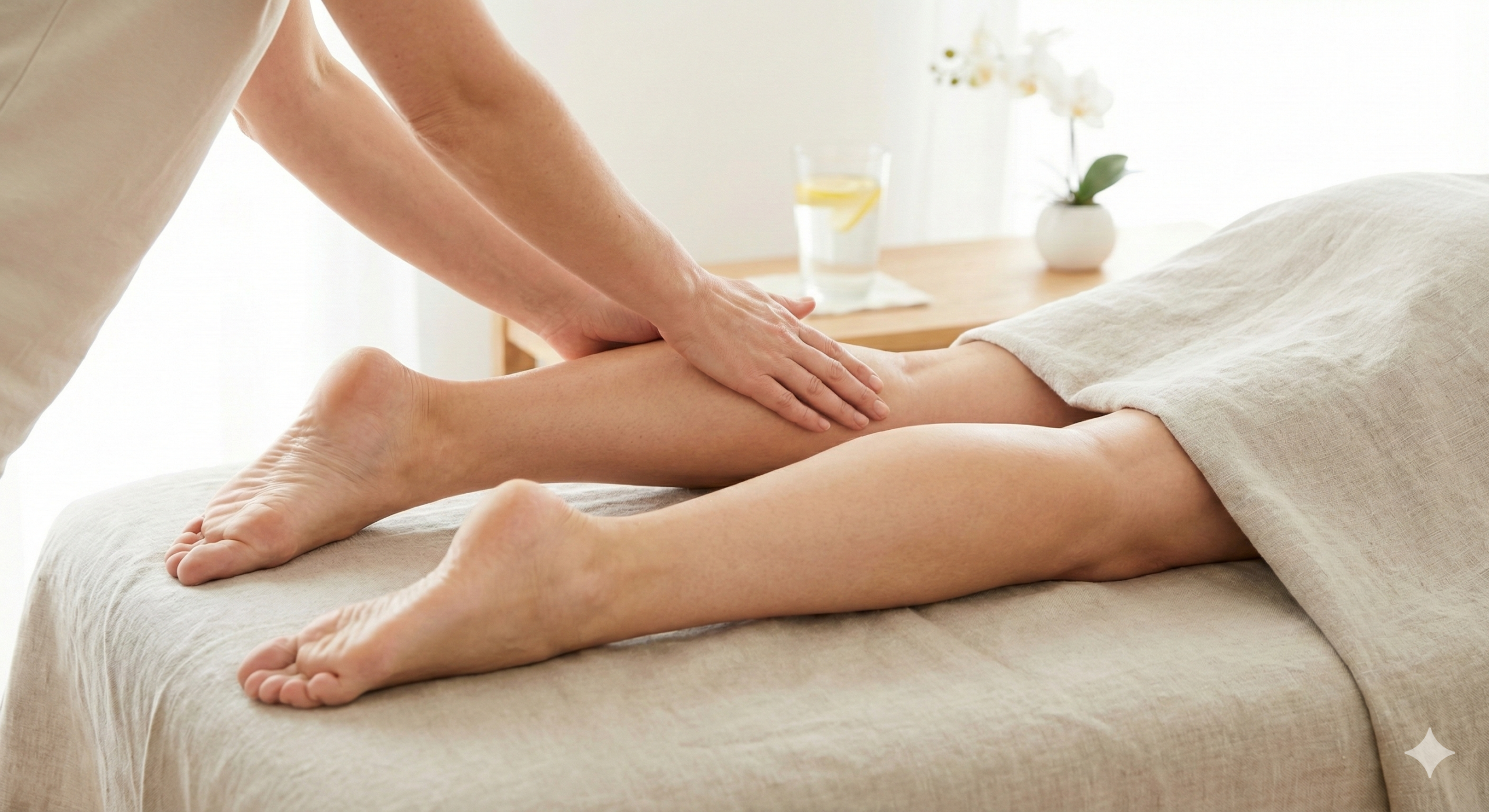
Treating “Heavy Legs” requires a subtle, technical, and rhythmic approach. We use a blend of Manual Lymphatic Drainage (MLD) techniques and gentle mobilisation.
1. The Feather-Light Touch (The “Touch” Principle)
Lymphatic capillaries are located just underneath the skin, not deep in the muscle. To access them, I use a specific, very light pressure. The Technique: I use slow, rhythmic, semi-circular movements that stretch the skin gently. The Mechanism: This skin-stretching action pulls on tiny “anchoring filaments” attached to the lymph vessels. It literally opens the trapdoors of the capillaries, allowing the stagnant fluid to flood in and be carried away. It is precise, almost hypnotic work.
2. Opening the Terminus (The “Awareness” Principle)
We cannot drain the legs if the drainpipe upstream is blocked. The Technique: Before I even touch your legs, I will work on your neck (supraclavicular nodes) and your abdomen (cisterna chyli). The Mechanism: These are the main dumping grounds for the lymph fluid. By stimulating these deep nodes first, we create a vacuum effect (negative pressure) that helps suck the fluid up from the legs.
3. Passive Mobilisation (The “Movement” Principle)
Once the superficial fluid is moving, we need to engage the deeper vessels. The Technique: I will gently pump your ankles and rhythmically rock your calves. The Mechanism: This mimics the natural muscle pump. It squeezes the deeper veins and lymph trunks, forcing the fluid upwards against gravity. It is the perfect antidote to the sedentary heaviness of modern life.
The Holistic Bridge: Releasing Emotional Weight
In holistic therapy, we understand that “issues are in the tissues.” The lymphatic system is the body’s sewage system. It deals with waste, toxins, and debris.
Metaphorically, when the lymph stagnates, it often correlates with a time in life where we feel stuck. We are holding onto things we no longer need. Old resentments. Old identities. The burdens of caring for everyone else.
Menopause is a massive transition. It is a time of clearing out.
When women come to me with “heavy legs,” they often describe feeling emotionally burdened, as if they are carrying the weight of the world. They feel unable to move forward.
The rhythmic, repetitive nature of lymphatic massage is deeply soothing to the Parasympathetic Nervous System. It allows for a profound “letting go.” As we physically encourage the body to release its waste fluid, we often find that the mind releases its grip on emotional heavy lifting too.
Clients often report needing to use the bathroom immediately after a session (a great sign the kidneys are processing the fluid) and feeling a sense of “lightness” that is as much emotional as it is physical.
Your Home Care: The ‘Light Legs’ Protocol
Massage is the jump-start, but you need to keep the engine running at home. Here are four science-backed ways to support your lymphatic system during menopause:
1. Legs Up the Wall (Viparita Karani)
This is the single most effective yoga pose for fluid retention. How to do it: Lie on the floor with your bum close to the skirting board and your legs resting vertically up the wall. Stay there for 10 to 15 minutes in the evening. Why it works: It uses gravity to drain the venous blood and lymph out of the legs and back towards the heart and kidneys for filtration. It is instant relief.
2. Hydration (The Paradox)
It feels counter-intuitive. If you are retaining water, surely you should drink less? The Truth: No. If you are dehydrated, your body hoards water as a survival mechanism. By drinking plenty of water, you signal to your body that it is safe to let go of the stored fluid. Tip: Add a slice of lemon or cucumber to natural mineral water. Avoid excessive caffeine, which can dehydrate the tissues.
3. Dry Skin Brushing
This is a daily habit that mimics the massage techniques we use in the clinic. How to do it: Before your shower, use a natural bristle brush. Always brush upwards towards the heart. Start at the feet, move up the calves, over the thighs, and towards the groin (where the inguinal lymph nodes are). Why it works: It physically stimulates the opening of the lymph capillaries and exfoliates the skin, improving that “back-pressure” elasticity we discussed earlier.
4. Rebounding or Walking
The lymph needs movement. The Practice: A gentle walk is better than a run. The rhythmic heel-strike of walking activates the calf pump. Alternatively, a mini-trampoline (rebounder) is incredible for lymph flow. The G-force of the gentle bounce opens and closes the lymph valves efficiently without stressing the joints.
When to Seek Medical Advice
While heavy legs are a common symptom of menopause, we must be vigilant. If you experience:
- Swelling in only one leg.
- Heat, redness, or pain in the calf.
- Shortness of breath.
Please see your GP immediately, as these can be signs of a DVT (blood clot) or other medical issues. Holistic massage is a support therapy, not a replacement for medical care.
Reclaim Your Bounce
You do not have to trudge through your forties and fifties. That feeling of heaviness is not a permanent state; it is a signal that your filtration system is just a little overwhelmed.
By understanding the biology of your changing hormones and applying the gentle, rhythmic support of lymphatic work, we can clear the stagnation.
Imagine waking up and feeling like your legs belong to you again. Imagine putting on your shoes without them cutting in. Imagine walking with a sense of flow rather than friction.
It is time to lighten the load.