Have you ever found yourself weeping in the supermarket car park because they were out of your favourite bread?
Or perhaps you have felt a sudden, volcanic surge of rage because someone chewed their food too loudly. Maybe you are sitting in a meeting, fully composed on the outside, while on the inside you are battling a wave of grief that feels as old as the hills.
If this sounds familiar, I want to offer you two words of reassurance: You’re normal.
The transition through perimenopause and menopause is not just a physical event. It is a seismic emotional shift. For many women, the “mental load” we have been carrying for decades suddenly feels too heavy to bear. The armour we built to survive our busy lives starts to crack.
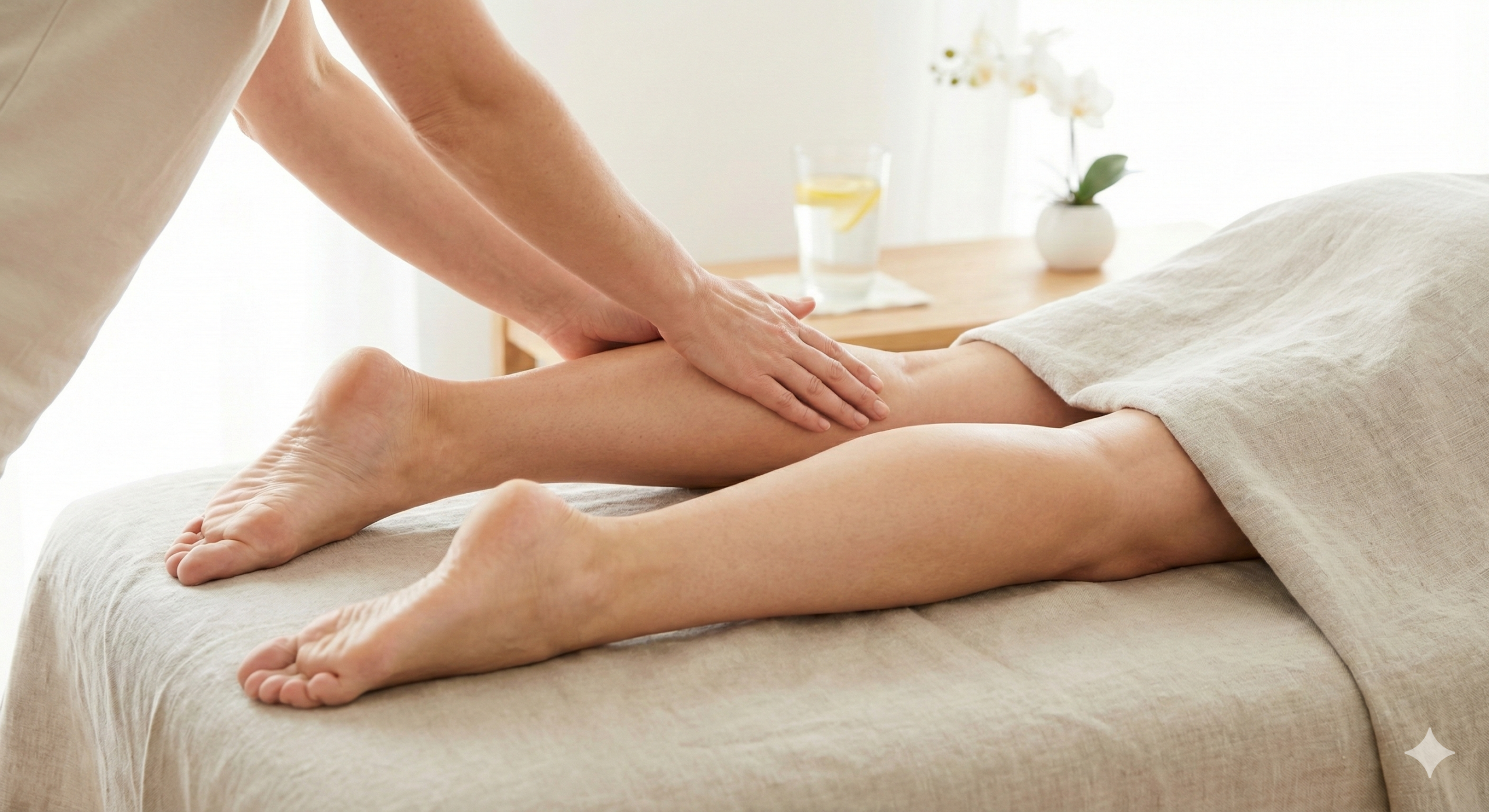
In my clinic, I see this every day. A client lies down for a deep tissue massage, and as soon as I touch a tight shoulder or hold the back of the neck, the tears come. They often apologise immediately. “I am so sorry,” they say. “I don’t know where that came from.”
I always tell them the same thing: You do not need to apologise. Your body is doing exactly what it needs to do.
This phenomenon is known as Emotional Release. In holistic therapy, we call the container for this experience “Holding Space.” While it sounds like a spiritual concept, it is grounded in hard neuroscience. It involves the Vagus Nerve, the fascia, and the complex biochemistry of safety.
Let’s explore why the massage table is one of the safest places to let go, and how we use the science of connection to help you find your footing again.
The Neurobiology of the “Menopausal Meltdown”
To understand why you feel so raw, we have to look at the brain.
For years, oestrogen has been acting as a neuro-protector in your brain. It helps regulate neurotransmitters like serotonin (the happy chemical), dopamine (the reward chemical), and GABA (the calming chemical). It essentially acts as a buffer against stress.
As oestrogen levels fluctuate and decline, that buffer wears thin.
1. The Reactive Amygdala
Without the soothing influence of oestrogen, the amygdala (the brain’s threat detection centre) becomes more reactive. It starts interpreting minor stressors as major threats. This is why a lost set of keys can trigger a full-blown panic attack. You aren’t “being dramatic.” Your threat detection system is currently calibrated to “High Alert.”
2. The Shrinking “Window of Tolerance”
Psychologists talk about the “Window of Tolerance.” This is the zone where you can handle the ups and downs of life without falling apart.
- Hypo-arousal: Numbness, depression, dissociation.
- Hyper-arousal: Anxiety, rage, panic.
- The Window: Calm, connected, capable.
Chronic stress and hormonal chaos shrink this window. It takes very little to push you out of your comfort zone and into a state of overwhelm.
What Does “Holding Space” Actually Mean?
In the wellness world, “holding space” is a buzzword that is often misunderstood. It does not just mean “sitting there silently.”
From a Bristol Diploma perspective, holding space is an active, physiological intervention. It is the creation of a container so safe that your nervous system feels permission to power down its defences.
The scientific term for this is Co-regulation.
As humans, we are wired to sync up with the nervous systems of those around us. If you are distressed and I come into the room feeling stressed and rushed, your mirror neurons pick up on my state. Your anxiety will spike.
However, if I approach the table with a regulated, grounded nervous system (slow breath, soft eyes, calm voice), I act as an anchor. Through a process called Neuroception (coined by Dr Stephen Porges), your subconscious mind scans me for safety cues.
When it finds them, it signals your Vagus Nerve to switch from “Defence” to “Social Engagement/Safety.” This is when the release happens. You can finally put down the heavy load because your biology registers that someone else is there to help hold it.
The “Issues in the Tissues”: Why Massage Triggers Emotion
Why does touching a shoulder release grief? Why does working on the hips release anger?
We often say “the issues are in the tissues.” While this is a holistic rhyme, the science behind it lies in Fascial Memory and Protective Bracing.
1. The Body Keeps the Score
When we experience an emotion we cannot process at the moment (because we are at work, or caring for children), we suppress it. We literally “swallow” our tears or “bite” our tongue. Physically, this suppression requires muscular effort. We tighten the jaw, we clench the pelvic floor, we hike the shoulders toward the ears. Over years, this becomes a habit. The fascia (connective tissue) hardens around this holding pattern. The emotion becomes trapped in the physical structure of the body.
2. The Trigger Point Release
When I apply deep, respectful pressure to these chronically tight areas, I am stretching the mechanoreceptors in the fascia. This input travels to the Insula—the part of the brain involved in Interoception (sensing the internal state of the body) and emotional processing. By mechanically releasing the physical lock, we often unlock the emotional vault. The memory or feeling associated with that tension bubbles up to the surface.
This is not a bad thing. It is the body attempting to Complete the Stress Cycle.
Animals in the wild shake or tremble after escaping a predator. Humans rarely do this. We hold it in. Emotional release on the massage table is your body’s way of finally shaking off the stress of the last decade.
The Touch Protocol: Engineering Safety
Because emotional release can be intense, safety is my primary clinical objective. I do not force release. I invite it.
Using the Bristol principles of Rapport and Touch, I use specific techniques designed to soothe the nervous system and widen your Window of Tolerance.
1. C-Tactile Afferents: The Touch of Kindness
Your skin has specific nerve fibres called C-Tactile Afferents. These nerves are not interested in “facts” (is it hot, sharp, rough?). They are interested in emotion. They respond optimally to slow, light stroking at a speed of 1 to 3 centimetres per second.
- The Technique: I often begin or end a session with slow, sweeping effleurage movements down the back or arms.
- The Mechanism: This speed stimulates the release of Oxytocin (the bonding hormone) and reduces cortisol. It tells the brain “You are cared for.” It is the biological antidote to isolation.
2. The Power of Stillness
Sometimes, movement is too much. If a client is in a state of high anxiety, rhythmic movement might feel chaotic.
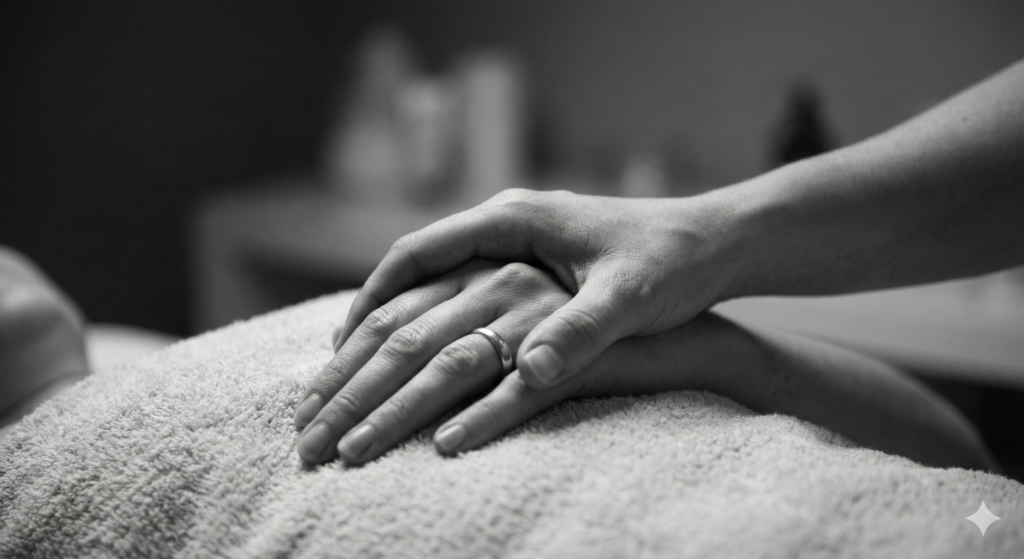
- The Technique: I may simply place my hands on your shoulders or your solar plexus and hold them there, completely still, for several minutes.
- The Mechanism: This static contact provides a clear, unwavering signal of support. It allows your proprioception (body awareness) to settle. It says “I am here. I am not going anywhere.”
3. Respectful Draping and Boundaries
Safety is impossible without clear boundaries.
- The Protocol: You are always securely covered with warm towels (draping). Only the area being treated is exposed.
- The Benefit: This eliminates subconscious vigilance. If you are worried about being exposed, your brain stays in “alert” mode. By managing the physical boundaries impeccably, I allow your mind to wander freely, knowing your dignity is protected.
The Benefit: Why “Breaking Down” is Actually “Breaking Through”
Society tells us that crying is a weakness. In the context of menopause, we are often terrified of being seen as “hysterical.”
I want to reframe this for you.
Releasing emotion on the table is a physiological cleaning process.
1. Lowering the Allostatic Load Allostatic load is the “wear and tear” on the body which accumulates as an individual is exposed to repeated or chronic stress. By discharging the emotional energy, you lower this load. This reduces inflammation and lowers blood pressure.
2. Clarity and Connection After a release, clients often report a feeling of “cleanliness” or lightness. The brain fog lifts. The “Menopause Rage” subsides because the pressure valve has been opened. You leave the session feeling more connected to yourself and less reactive to the world.
3. Returning to the “Second Spring” In Traditional Chinese Medicine, menopause is called the “Second Spring.” It is a time of rebirth. But to be reborn, we often have to grieve who we were. Holding space allows you to process the grief of the lost youth so you can step fully into the power of the wise woman.
Your Home Toolkit for Emotional Safety
You cannot always get to the clinic when the wave of emotion hits. Here are three holistic, science-backed ways to hold space for yourself at home:
1. The “Constructive Rest” Position
This is a zero-effort pose that resets the psoas muscle (the “muscle of the soul” which holds fear).
- How to do it: Lie on your back on the floor. Bend your knees and place your feet flat on the floor, wider than your hips. Let your knees knock together so they support each other. Place your hands on your belly.
- Why it works: It releases tension in the lower back and pelvis without you having to “do” anything. Stay there for 10 minutes and just breathe.
2. Self-Havening Touch
Havening is a psychosensory therapy that uses touch to alter brain chemistry.
- How to do it: Cross your arms over your chest. Stroke your hands firmly from your shoulders down to your elbows, repeatedly.
- Why it works: This mimics the self-soothing gestures we use instinctively. It generates Delta waves in the brain, which are associated with deep sleep and restoration.
3. “Name it to Tame it”
This concept comes from Dr Dan Siegel.
- How to do it: When you feel a surge of rage or grief, say it out loud. “I am feeling grief right now.”
- Why it works: Labelling an emotion moves the activity from the Amygdala (panic centre) to the Prefrontal Cortex (logic centre). It immediately reduces the intensity of the feeling.
An Invitation to Unravel
If you have been holding it all together for everyone else, I invite you to put the burden down for an hour.
You do not need to be “good” on my table. You do not need to be quiet. You do not need to be strong.
In my treatment room, every part of you is welcome. The grief, the rage, the joy, and the tears. We will use the science of safety and the art of holistic touch to help you navigate this transition with grace.
Your body is not “acting up.” It is speaking up. Let’s listen to it together.
Frequently Asked Questions (FAQ)
What if I cry during the massage? Will it be awkward? Not at all. I am fully trained to support emotional release. I will not try to “fix” you or make you stop. I will simply adjust the treatment (perhaps moving to holding points or feet) to support you until the wave passes. Tissues and water are always to hand.
Why do I feel angry after a massage sometimes? This is very common. As we release tension from the jaw, neck, or hips, we often release suppressed anger or frustration. It is a sign the treatment is working. Try to move your body (walk, shake) and drink plenty of water to help the process move through.
Can massage help with menopause anxiety? Yes. By stimulating the Parasympathetic Nervous System (Rest and Digest), massage lowers cortisol and adrenaline. Regular treatments can help raise your baseline for stress, making you less reactive to daily triggers.
Do I have to talk during the session? No. This is your time. Some clients process verbally; others prefer total silence. I take my cues from you. If you need to talk, I am here to listen. If you need quiet, I will hold the silence.