
Do you ever feel like you are running a marathon, even when you are sitting perfectly still on the sofa?
It is a familiar story in my clinic. A client, usually in her mid-40s or 50s, lies down on the table and lets out a breath that sounds like it has been held for three years. She tells me about the heart palpitations in the supermarket queue. The sudden, illogical surges of anxiety that wake her at 3 AM. The feeling of being “wired but tired”—exhausted to the bone, yet unable to switch off a racing brain.
If this resonates, I need you to know something crucial: This is not a personality flaw. You are not failing to cope. This is a physiological reality of the menopausal transition.
Perimenopause does not just change your reproductive system; it significantly recalibrates your nervous system. The hormonal buffer that once kept you resilient to stress is thinning out.
The good news? You have an internal “reset button” waiting to be pressed. It is called the Vagus Nerve. And through specific, rhythmic, and focused massage therapy, we can “hack” into this system to turn down the noise and bring you back to yourself.
Here is the science of why you feel so overwhelmed, and how holistic bodywork provides the antidote.
The Internal Seesaw: Your Autonomic Nervous System
To understand why you feel permanently on edge, we need to look at the Autonomic Nervous System (ANS). This is the body’s automatic control centre, managing everything you don’t have to think about: heart rate, digestion, breathing, and arousal.
The ANS operates like a seesaw with two main modes:
1. The Sympathetic Nervous System (SNS) – “Fight or Flight”
This is your survival mode. When your brain perceives a threat—whether that’s a sabre-toothed tiger or an overflowing inbox—the SNS floods your body with cortisol and adrenaline. Your heart races, your muscles tense for action, and non-essential systems (like digestion and libido) shut down.
2. The Parasympathetic Nervous System (PNS) – “Rest and Digest”
This is your restoration mode. It is the state required for deep sleep, cellular repair, nutrient absorption, and emotional calm.
The Perimenopause Problem: Oestrogen and progesterone act as natural calming agents for the brain. As these hormones begin to fluctuate wildly and eventually decline, your nervous system loses its stabilisers.
Suddenly, the “Fight or Flight” response becomes trigger-happy. A minor stressor that you would have brushed off five years ago now sends your system into red alert. Many women in menopause find their seesaw is stuck firmly down on the “Fight or Flight” side. They are living in a state of chronic, low-level sympathetic dominance.
This is what causes the anxiety, the digestive issues (the famous “meno-belly”), and the inability to rest deeply. Your body thinks it is under constant attack.
Meet the Vagus Nerve: Your Body’s Superhighway to Calm
If the SNS is the accelerator pedal, what is the brake?
Enter the Vagus Nerve.
Originating in the brainstem and wandering down through the neck, chest, and abdomen (Vagus means “wanderer” in Latin), this is the longest cranial nerve in your body. It touches almost every major organ—heart, lungs, gut.
The Vagus Nerve is the captain of the “Rest and Digest” system. When stimulated, it releases acetylcholine, a neurotransmitter that acts as a natural tranquiliser. It tells your heart rate to slow down, your blood pressure to drop, and your digestion to restart.
Crucially, it tells your brain: “You are safe now.”
The Concept of “Vagal Tone”
Scientists talk about “vagal tone.” High vagal tone means your brake pedal works efficiently—you can bounce back from stress quickly. Low vagal tone (common in chronic stress and menopause) means the brake is sticky. It takes much longer to calm down once upset.
Our goal in holistic therapy is to increase your vagal tone. We want to oil that brake pedal so you can shift gears smoothly.
The “Hack”: How Holistic Massage Targets the Vagus Nerve
You might be thinking, “That sounds great, but can’t I just take a deep breath?”
Yes, deep breathing helps. But when your nervous system is fundamentally frayed, you often need an external intervention to break the loop. You need physical proof of safety.
This is where high-end holistic massage differs significantly from a standard, muscular rub-down. In my practice, drawing on the Bristol Diploma principles of rhythm and rapport, I don’t just treat muscles; I treat the nervous system.
We cannot force the Vagus Nerve to engage. We have to coax it through feelings of safety and specific physiological cues.
Here is how we do it on the table:
1. Establishing Safety (The “Rapport” Principle)
The Vagus Nerve is highly sensitive to cues of danger or safety in the environment (a process called neuroception). Before I even touch you, the environment must signal safety. Warmth, hushed tones, and a thorough consultation where you feel truly heard are the foundations. If your brain doesn’t feel safe with me, your Vagus Nerve will remain offline.
2. Working the Neck and Occiput
The Vagus Nerve exits the brain just behind the ears and travels down the side of the neck. Tension here—the classic “tech neck” or stress-shoulders—can actually impinge on vagal function. We use slow, sustained craniosacral holds at the base of the skull (the occiput) and gentle, precise mobilisation of the neck muscles. This isn’t about cracking; it’s about melting the fascia around the nerve pathway to allow for clear signalling.
3. Rhythmic Pumping and Mobilisation
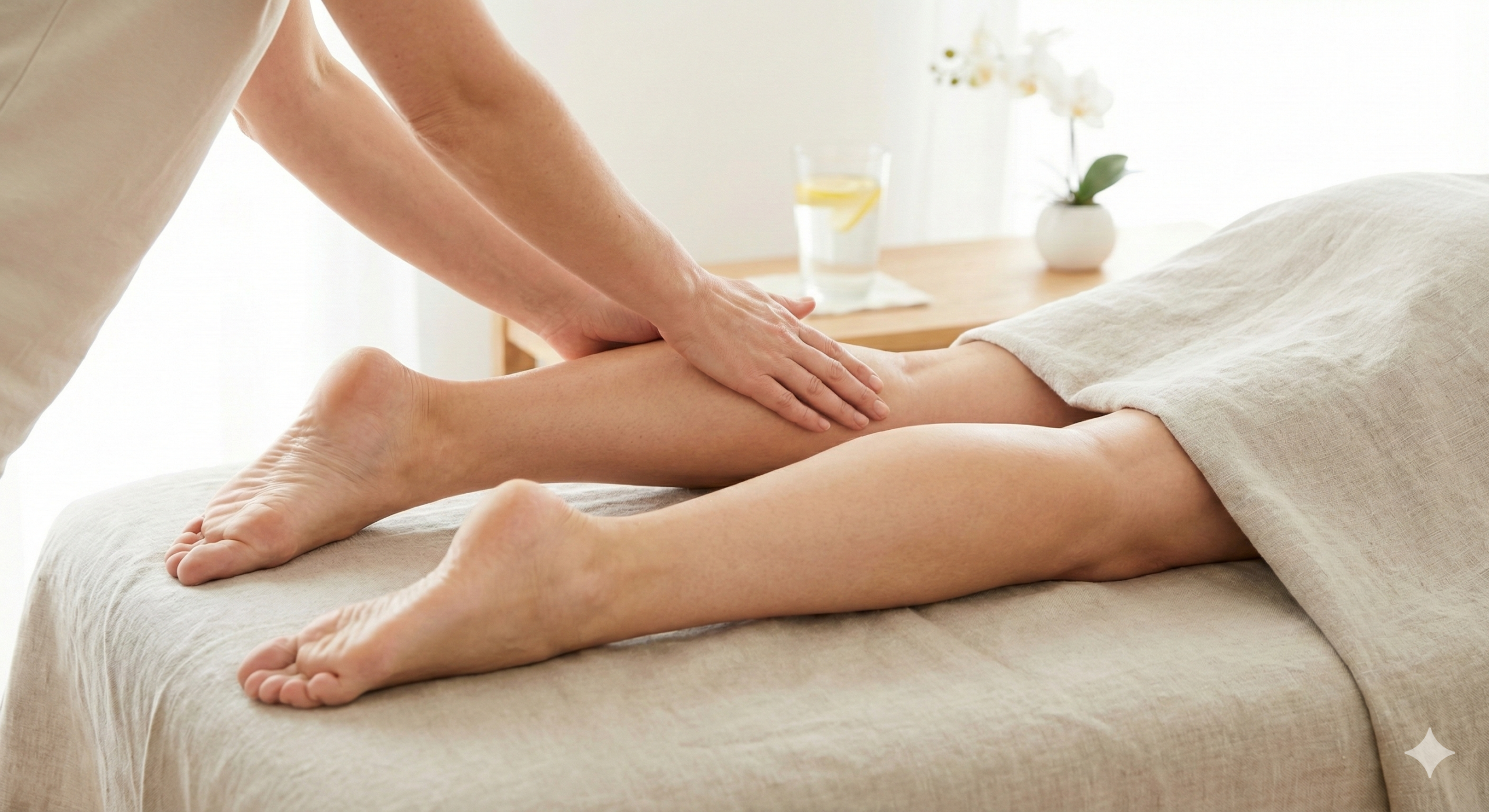
The nervous system loves rhythm. It reminds us of the heartbeat in the womb. Jerky, fast massage techniques can accidentally trigger the “Fight or Flight” response. Instead, I use slow, rhythmic compressions on the limbs and gentle rocking of the body. This predictable, wave-like motion is deeply sedating to the nervous system, lulling the brain into a state of surrender.
4. The Diaphragm Connection
The Vagus Nerve passes right through the diaphragm (your main breathing muscle) on its way to the gut. When you are stressed, your diaphragm tightens, and your breathing becomes shallow. We use specific abdominal massage techniques and guided breathwork to release tension in the solar plexus and diaphragm. This physically frees the path for the Vagus Nerve and encourages deeper belly breathing, which is the fastest way to manually stimulate the PNS.
5. Abdominal Therapy for the Gut-Brain Axis
80% of the Vagus Nerve fibres send signals from the gut to the brain. If your gut is unhappy (bloated, constipated—common in menopause), it sends alarm signals upwards. Gentle, respectful abdominal massage soothes the enteric nervous system (the “second brain” in your gut), sending signals of calm back up the superhighway to your head.
The Result: Moving from Surviving to Thriving
What does it feel like when we successfully “hack” the Vagus Nerve during a session?
Clients often describe a profound shift. It’s not just “relaxing”; it’s a physiological gear change. You might feel your stomach gurgle loudly (a brilliant sign that “Digest” mode has kicked in). You might feel a sudden wave of emotion as the armour of “Fight or Flight” melts away. You might find yourself drifting into that liminal space between sleep and wakefulness.
This is where healing happens. In this state, your cortisol levels drop, and your body floods with oxytocin and serotonin. You are moving from a state of constant inflammatory defence to a state of restoration.
Regular holistic massage therapy acts as training for your nervous system. We are re-teaching your body what “safe” feels like, increasing your vagal tone so that when daily stressors hit, you have the resilience to bounce back without spiralling into anxiety.
Menopause is a time of intense change, but you are not meant to endure it in a state of permanent panic. By respecting the biology of your nervous system and using the ancient power of informed touch, we can help you reclaim your calm.
You don’t have to fight your body. You can learn to work with it.