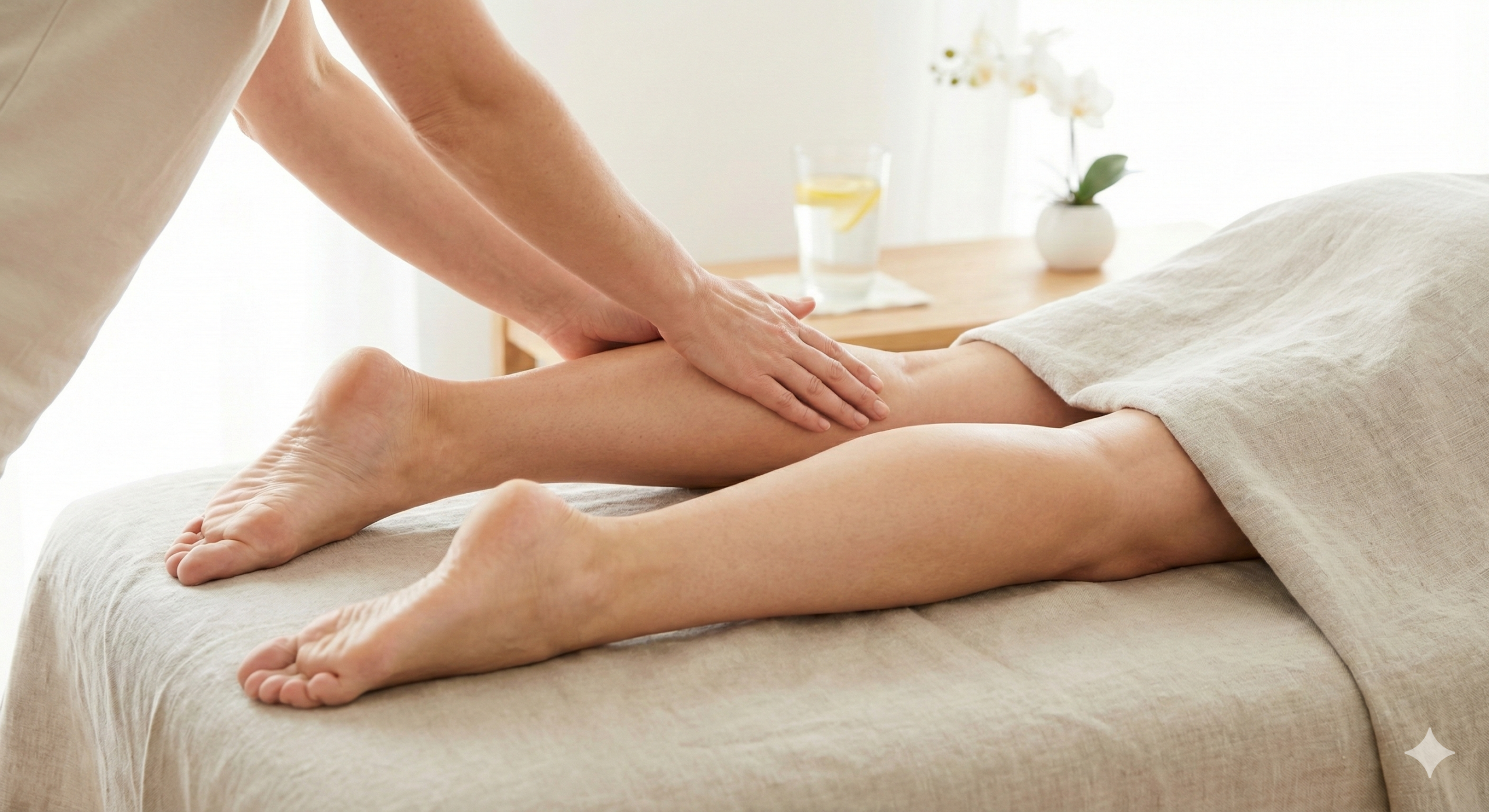
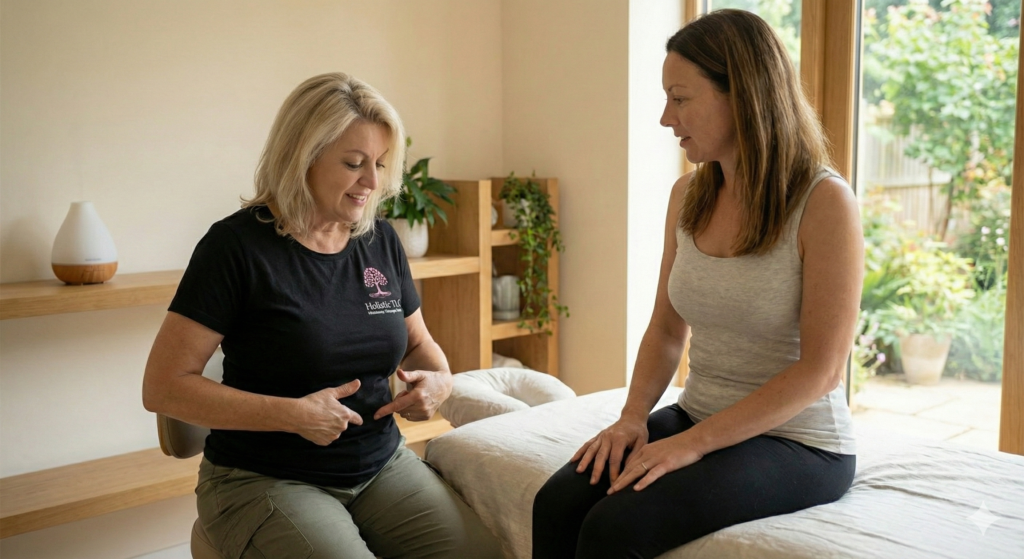
When was the last time you touched your stomach with kindness?
If you are like many of the women I see in my clinic, the answer might be “never.” For women navigating perimenopause and menopause, the midsection often becomes “enemy territory.” It is the part of the body we have been conditioned to suck in, shapewear away, and apologise for.
And then, the hormones shift. Suddenly, despite no change in diet or exercise, you might notice a thickening waistline. You might feel perpetually bloated, as if you have swallowed a football. You might feel a heaviness that makes you want to disconnect from your body entirely.
We call it “Menopause Belly,” a term often laden with shame. But what if I told you that this area—your soft, changing middle—is actually the engine room of your mental health?
As a holistic therapist, I want to invite you to change the narrative. We need to stop fighting the middle and start listening to it. By combining the ancient art of abdominal massage with modern understanding of the Gut-Brain Axis, we can alleviate physical bloating and unlock a powerful source of serotonin.
Let’s explore the science of why your middle is changing, and how we can use touch to make friends with it again.
The Science: Why the “Meno-Belly” Happens
First, a reality check: You have not failed. You are not just “letting yourself go.” The changes in your abdominal area are a physiological response to a changing internal climate.
1. The Cortisol Switch
As oestrogen levels decline, your body searches for a new way to protect itself. Oestrogen is anti-inflammatory. When it leaves the building, your body becomes more sensitive to stress. In response, your adrenal glands pump out more cortisol (the stress hormone).
Cortisol has a very specific job: it mobilises energy for a “fight or flight” response. But if you don’t burn that energy off (by fighting a tiger), cortisol tells your body to store fat. Crucially, it directs fat specifically to the visceral area (deep inside the abdomen) because visceral fat has four times more cortisol receptors than fat elsewhere. Your body is trying to build a protective armour around your vital organs.
2. The Great Slow-Down (Peristalsis)
Oestrogen and progesterone also play a role in gut motility—the speed at which food moves through your system. As these hormones fluctuate, peristalsis (the wave-like muscle contractions that move food) can become erratic or sluggish. This stagnation leads to fermentation in the gut, which creates gas. That “six months pregnant” look you get by 4 PM? That is often trapped gas and slow transit, not fat.
The “Second Brain”: The Serotonin Surprise
Here is the piece of science that usually shocks my clients: 90% to 95% of your body’s Serotonin is found in your gut, not your brain.
We tend to think of serotonin as a brain chemical—the “happy hormone” that antidepressants try to regulate. But the vast majority of it is manufactured and stored in the Enteric Nervous System (ENS), which lines your gastrointestinal tract.
This is the Gut-Brain Axis. Your gut and your brain are in constant communication via the Vagus Nerve.
- When your gut is happy: It produces ample serotonin, which signals the brain to feel calm, optimistic, and stable.
- When your gut is unhappy: If you are constipated, bloated, or holding tension in your abdomen, serotonin production is disrupted. This sends “alarm” signals up the Vagus Nerve, contributing to anxiety, brain fog, and low mood.
The Bridge: This is why “gut feelings” are real. If you are feeling low, anxious, or tearful during menopause, treating the mind alone is often not enough. We have to treat the gut where the happiness chemicals are made.
The Massage Intervention: Deep, Respectful Connection
In the UK, abdominal massage is often overlooked or rushed through during a full-body treatment. However, in my practice—rooted in the Bristol Diploma tradition—it is often the star of the show.
It is normal to feel nervous about having your stomach touched. It is a vulnerable area where we store a lot of “emotional digestion.” That is why my approach is built entirely on Rapport and Safety.
Here is what happens during a session:
1. Warming the Foundation (The “Touch” Principle)
We never dive straight in. We begin with gentle, rhythmic rocking of the hips and ribs to signal safety to the nervous system. I use warm oil and broad, flat-handed contact to introduce heat to the area. This heat helps to dilate the blood vessels, bringing fresh, oxygenated blood to sluggish organs.
2. Following the Flow (The “Movement” Principle)
The colon (large intestine) flows in a very specific direction: up the right side (ascending), across the middle (transverse), and down the left side (descending). Using slow, deliberate, clockwise circles, I mechanically mimic the natural wave of peristalsis.
- The Scientific Mechanism: This is external mechanical stimulation. If your internal muscles are too tired or hormonal to move waste along, my hands provide the momentum. This helps break down pockets of trapped gas and encourages the movement of stool, relieving that heavy, stagnant feeling.
3. Deep Colon Work
Once the surface tension has melted, we can work deeper. Using slow, focused pressure (never pain), I can locate areas of restriction or adhesion in the mesentery (the tissue that holds your intestines in place).
- The Benefit: By gently mobilising these tissues, we improve the slide-and-glide of the visceral fascia. This reduces the feeling of tightness and “pulling” inside your abdomen.
4. Soothing the Solar Plexus
The solar plexus is a bundle of nerves sitting just below the ribcage. It is often tight in high-achieving, stressed women. Gentle work here directly sedates the Sympathetic Nervous System (Fight/Flight), flipping the switch to Parasympathetic (Rest/Digest).
The Emotional Release: Making Friends
The physical benefits—less bloating, better digestion, a flatter feeling—are wonderful. But the emotional shift is often profound.
We spend so much time dissociating from our stomachs. We try not to look at them; we try not to feel them. This creates a disconnect (poor Interoception) that makes it harder to understand what our bodies need.
During abdominal massage, I invite you to breathe into my hands. I invite you to feel the space you take up.
By bringing positive, non-judgmental touch to an area you may have rejected, we start to heal the relationship. You might feel a release of emotion—tears are common and welcome—as the tension of “holding it all in” finally dissipates.
When we clear the physical stagnation in the gut, we often clear mental stagnation too. Clients report leaving the session feeling lighter, not just in their waistband, but in their spirit.
Your “Second Spring” Self-Care
Abdominal massage is a powerful therapy, but you can support your gut health between sessions with these simple habits:
- The Clockwise Rub: Every night before sleep, lie on your back and massage your own belly in large, slow, clockwise circles (following the direction of digestion). This is a wonderful way to tell your nervous system it is time to sleep.
- Warmth is Key: The gut hates cold. During perimenopause, our digestion is weaker. Drink warm water with ginger rather than ice-cold drinks, and use a hot water bottle on your tummy if you feel anxious.
- Chew, Chew, Chew: Digestion begins in the mouth. If you eat in a rush, you swallow air (bloating) and send huge chunks of food to a stomach that is already struggling. Slow down.
A Final Thought
Your middle is not an enemy to be conquered. It is the centre of your intuition, the factory of your joy (serotonin), and the protector of your vital energy.
It deserves more than to be hidden away. It deserves to be handled with care, respect, and skill.
If you are tired of the bloating, the heaviness, and the war with your waistband, I invite you to experience the restoration of abdominal therapy. Let’s get things moving again—physically and emotionally.