
Do you ever wake up feeling like the Tin Man before he found his oil can?
You are not alone. One of the most common whispers I hear in my treatment room from women in their 40s and 50s is a confession of sudden, unexplained stiffness. It is the sensation that your body, which once felt pliable and resilient, has suddenly become brittle. You might feel “creaky” in the mornings, or find that an hour at your desk leaves your hips feeling locked in place.
It is easy to internalise this. We look in the mirror and think, “I am just getting old.” We might even feel a sense of betrayal—that our body is failing us.
I want to stop you right there. Your body is not failing; it is transitioning. And that feeling of “dryness” or stiffness isn’t all in your head—it is a very real physiological response to shifting hormones. But the good news? It is not permanent, and we can work with it.
Through a blend of science-backed bodywork and rhythmic mobilisation, we can encourage your body to “re-oil” its own gears. Let’s explore why you are feeling this way, and how we can bring the fluidity back.
The Science of the “Dry” Body
To understand why perimenopause makes us stiff, we have to talk about Oestrogen.
We often think of oestrogen solely as a reproductive hormone, the conductor of our monthly cycles. But oestrogen is a multitasking powerhouse. One of its crucial roles is maintaining the hydration and elasticity of our soft tissues. It essentially tells your body to hold onto water in the right places.
Specifically, oestrogen has a profound effect on fibroblasts—the cells responsible for building collagen and elastin. It also stimulates the production of a magical substance called glycosaminoglycans (GAGs), the most famous of which is Hyaluronic Acid.
You likely know Hyaluronic Acid from face creams that promise “plump, dewy skin.” Well, your body uses it internally for the exact same purpose. It acts as a lubricant and a shock absorber in your joints and connective tissues.
Here is the scientific reality: As oestrogen levels fluctuate and eventually decline during perimenopause and menopause, your production of collagen and Hyaluronic Acid drops.
Without that internal hydration, your tissues lose their “slide and glide.” Muscles that used to move freely over one another begin to stick. The fluid that cushions your joints (synovial fluid) becomes thinner and less abundant. The result? That pervasive feeling of friction, stiffness, and “rust.”
Fascia: Your Inner Wetsuit
To truly treat this stiffness, we cannot just look at muscles. We have to look at the fascia.
Imagine you are wearing a full-body wetsuit under your skin. This is your fascia—a continuous web of connective tissue that wraps around every muscle, bone, nerve, and organ.
In a healthy, hydrated body, fascia is like a fluid web. It is viscoelastic, meaning it stretches and returns to shape, allowing you to move with dynamic ease. The layers of fascia slide over each other effortlessly because they are lubricated with that Hyaluronic Acid we mentioned.
However, when inflammation rises (thanks to cortisol spikes) and oestrogen drops, fascia can become dehydrated. It transforms from a supple web into something resembling beef jerky or shrink-wrap. It becomes “sticky,” creating adhesions where layers of tissue glue together.
This creates a restriction of movement that you can’t just “stretch out.” In fact, static stretching often irritates dehydrated fascia. This is why you might feel tight even if you do yoga every day. The tissue doesn’t need pulling; it needs rehydrating.
The Massage Intervention: How We Restore Fluidity
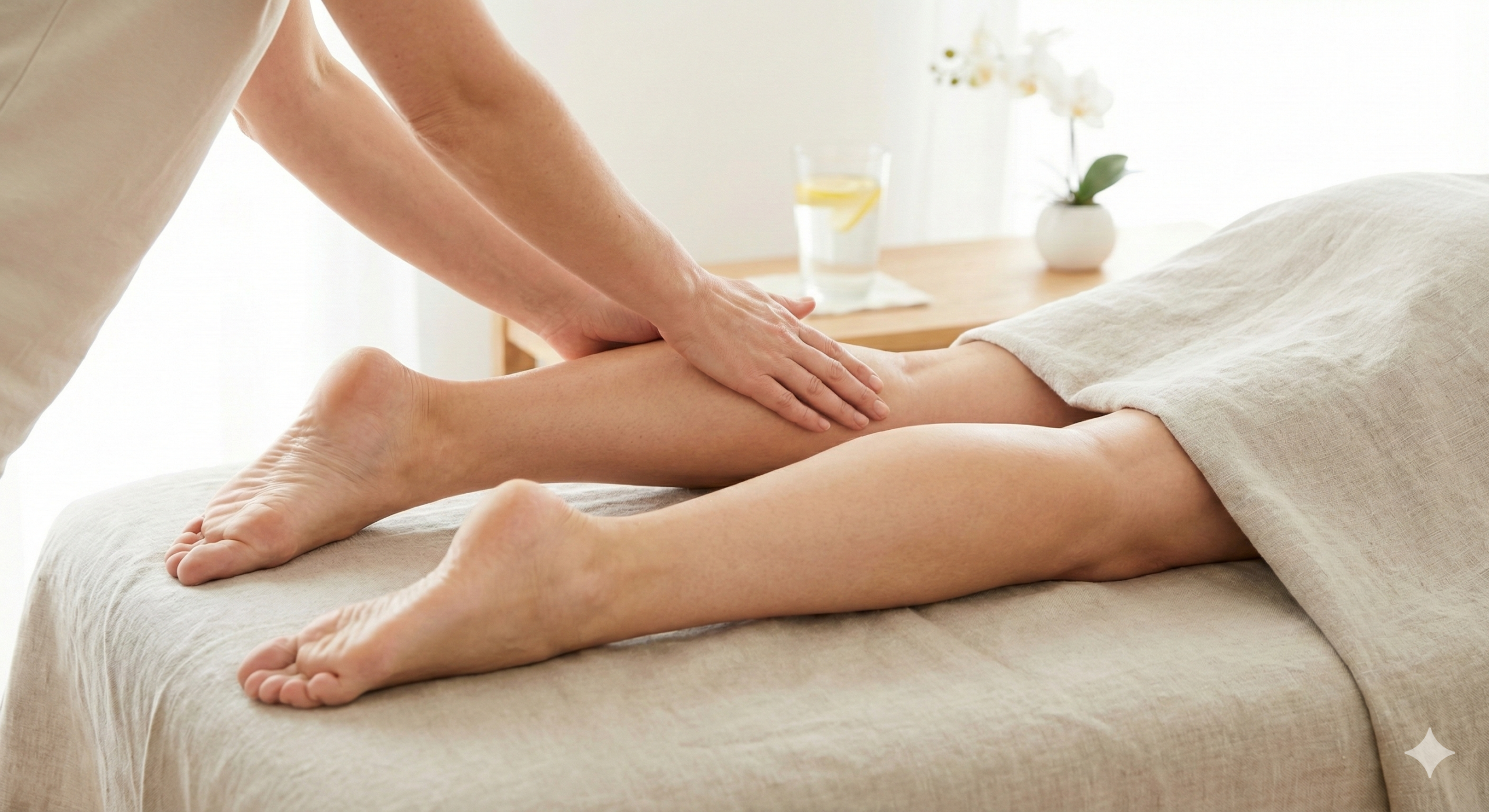
This is where the Bristol Diploma approach comes into its own. In my clinic, we do not simply rub oil on skin. We engage with the nervous system and the fascial matrix to signal a change in tissue quality.
We use the principle of Thixotropy.
Thixotropy is a property of certain gels and fluids (like your fascia) where they become more fluid when they are shaken, stirred, or heated, and more solid when they sit still. Think of ketchup in a glass bottle—it won’t come out until you tap it or shake it.
Static, heavy pressure does not always achieve this. Instead, I use a dynamic blend of techniques designed to shear, glide, and mobilise.
1. Rhythmic Mobilisation (The “Movement” Principle)
Rather than fixing you to the table, I incorporate movement into the massage. I might gently rock your hips, oscillate your shoulder joint, or use traction on your legs.
- The Holistic Feeling: A sense of lullaby-like rhythm that is deeply soothing and helps you let go of control.
- The Scientific Mechanism: This movement creates shear force between the layers of tissue. This mechanical stimulation signals the fibroblasts (remember them?) to wake up and produce more Hyaluronic Acid. We are literally encouraging your body to produce its own lubricant.
2. Myofascial Release (The “Touch” Principle)
This technique involves slow, sustained pressure that engages the barrier of the tissue without forcing through it.
- The Holistic Feeling: A deep, “melting” sensation, where it feels like the knot is dissolving under my hands.
- The Scientific Mechanism: This engages the Piezoelectric Effect. When pressure is applied to the crystalline structure of collagen, it generates a small electrical charge. This charge signals the tissue to reorganise and align, breaking down the chaotic “fuzz” of adhesions and restoring the tissue’s ability to glide.
3. Down-Regulating the Nervous System (The “Rapport” Principle)
We cannot rehydrate tissue if you are in a state of stress. High cortisol dries out the body further.
- The Holistic Feeling: Safety. The feeling of being “held” and listened to.
- The Scientific Mechanism: By stimulating the Vagus Nerve through respectful, paced touch, we shift your autonomic nervous system from Sympathetic (Fight/Flight) to Parasympathetic (Rest/Digest/Repair). It is only in this “Repair” state that your body can direct resources toward tissue regeneration and inflammation reduction.
Bridging the Gap: The Emotional Release
We must also acknowledge the emotional component of this stiffness. In Holistic therapy, we say “the issues are in the tissues.”
Menopause is a massive life transition. It can come with grief for the younger self, rage at the invisibility of aging, or anxiety about the future. When we suppress these emotions, we physically “brace” ourselves. We hold our breath; we hike our shoulders; we tighten our pelvic floor.
Over time, this emotional bracing becomes physical armouring. The fascia sets in these patterns of tension.
By working with Awareness (Interoception), I help you notice where you are holding on. During a session, I might ask you to breathe into a tight area, not just to relax the muscle, but to reconnect your brain to that part of your body.
When we release the physical tension in the fascia, we often see an emotional release too. It is not uncommon for clients to tear up or take a profound, shuddering breath on the table. This is welcome here. It is a sign that the “guard” is coming down, allowing the vital flow of energy—and blood—to return to the area.
Your “Second Spring” Strategy
While I can facilitate this rehydration in the treatment room, maintaining it requires a partnership between us. Here is how you can support your fascia between sessions:
- Hydrate Intelligently: Drinking water is vital, but if your tissues lack electrolytes, the water just passes straight through. Add a pinch of sea salt or lemon to your water to help absorption.
- Bounce and Shake: Remember thixotropy? Gentle bouncing (like on a rebounder or just shaking your limbs out in the kitchen) is better for hydrating fascia than static stretching.
- Collagen Support: Consider nutrition that supports collagen production—bone broths, Vitamin C, and quality proteins.
Reclaiming Your Vibrancy
If you take one thing away from this, let it be this: You are not drying up. You are simply navigating a change in your internal climate.
Stiffness is not a life sentence. It is a signal from your body asking for a different kind of attention—one that is less about forcing and punishing, and more about rhythm, hydration, and flow.
In our sessions, we move away from the idea of “fixing” a broken machine and move toward “tending” a living garden. We use the science of mechanotransduction and the art of compassionate touch to remind your body how to be fluid again.
You deserve to feel at home in your skin. You deserve to move with ease. Let’s get things moving again.